How to Find Your Break-Even Point
Find the number of units that cover your fixed costs from the price, the variable cost and the fixed costs, and see why the answer is rounded up.
Work out your profit for a period, the break-even point and the units a target needs, and see which of price, cost, volume or fixed costs moves profit most.
Enter your price, costs and sales for one period, such as a month. Results update as you type.
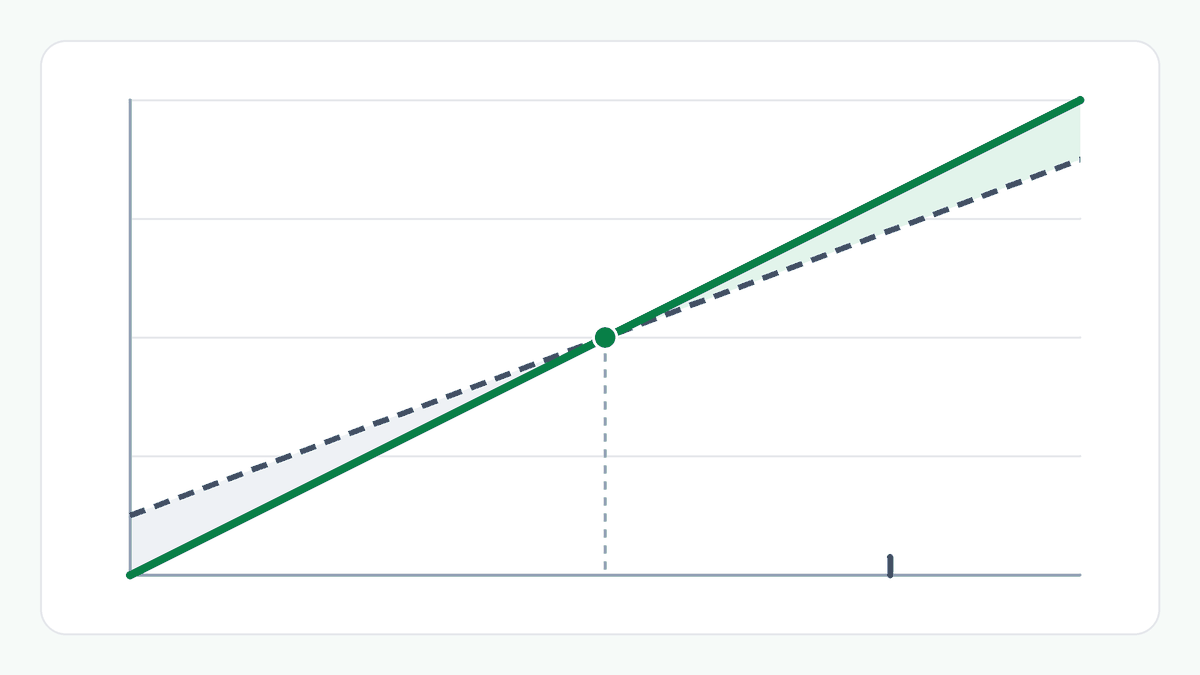
Each unit contributes something towards the fixed costs. The contribution is the selling price less the variable cost. Fixed costs are covered by the contributions of all the units sold, and anything beyond that is profit.
Break-even is a whole number of units. It is the fixed costs divided by the contribution, rounded up, because a fraction of a unit cannot be sold. If the contribution is zero or below, no number of units covers the fixed costs.
Above, at or short of break-even. The calculator compares the units sold with the break-even point and says how many units above or short of it you are.
The table shows what changes. It moves the selling price, the variable cost, the units sold and the fixed costs by 10%, one at a time, so you can see which one moves the profit most under your own numbers.
This is arithmetic on the numbers you enter, not an accounting statement and not advice. See the disclaimer.
Take a selling price of ₹800.00, a variable cost of ₹600.00 a unit, fixed costs of ₹50,000.00 and 400 units sold. Each unit adds ₹200.00, revenue is ₹3,20,000.00 and the profit is ₹30,000.00. 250 units cover the fixed costs, so the units sold are 150 units above break-even. A profit of ₹1,00,000.00 would need 750 units. If the selling price were 10% lower the profit would be -₹2,000.00, and 10% higher, ₹62,000.00.
contribution per unit = selling price - variable cost
profit = contribution per unit × units sold - fixed costs
Break-even units are the smallest whole number of units where the contribution of all the units covers the fixed costs: the fixed costs divided by the contribution, rounded up. Units for a target profit are worked out the same way from the fixed costs plus the target.
Each row of the table changes one input by 10% and works the whole result out again from that input. A changed number of units is rounded to the nearest whole unit.
A variable cost goes up with each unit you make or sell, such as materials or packing. A fixed cost stays the same for the period whatever you sell, such as rent. Enter each in its own field.
You cannot sell part of a unit, so the fixed costs divided by the contribution is rounded up to the next whole unit. At that many units the fixed costs are covered.
Each sale then adds to the loss, so no number of units covers the fixed costs. The calculator shows the loss and says there is no finite break-even.
No. It calculates the figures for the numbers you enter. Whether those numbers are enough depends on costs and plans that are not part of this calculation.
No. Enter the price and costs without GST. No tax is calculated.