1. One Plan, One Change at a Time
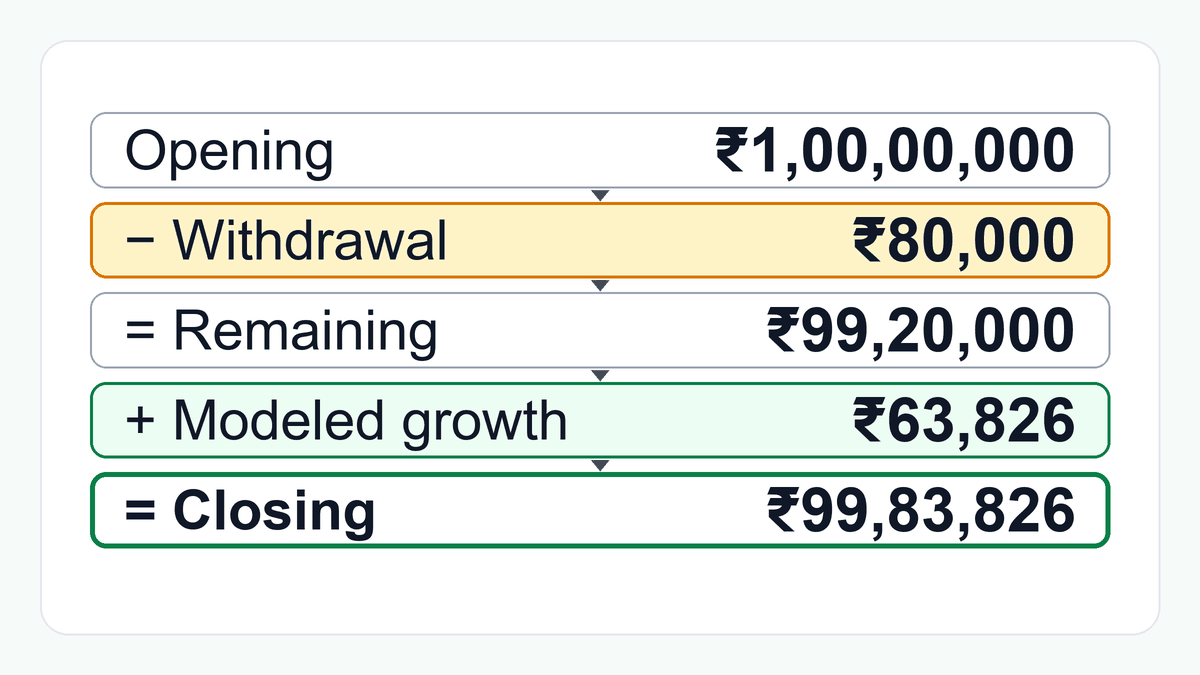
The baseline is a corpus of ₹1 crore, a withdrawal of ₹80,000 a month taken at the start of each month, an assumed return of 8% a year and no yearly increase. In the model it lasts 20 years 10 months.
Each section below changes one of those assumptions and leaves the rest as they are. A duration here counts the full monthly withdrawals, so a small part-paid withdrawal at the end is not counted as time.
2. The Assumed Return
At an assumed 6% the same plan lasts 15 years 11 months, which is 4 years 11 months less than the baseline. At 9% it lasts 26 years 1 month, and at 10% it lasts 47 years 2 months.
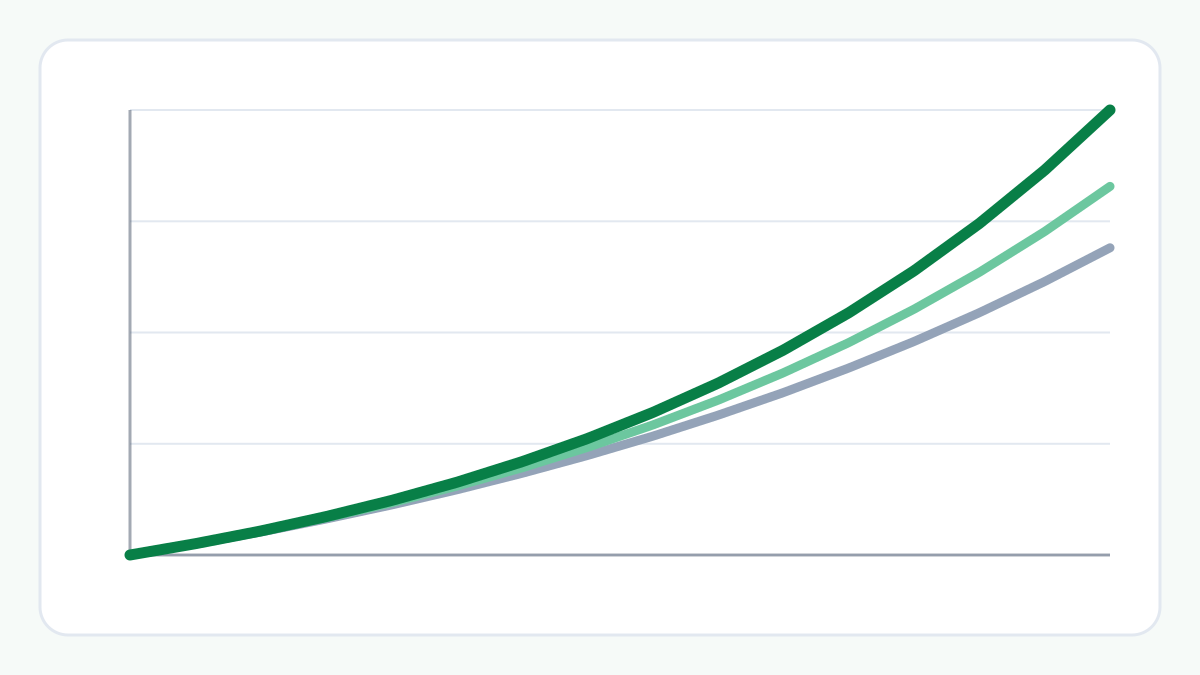
The effect is lopsided. Two points lower costs 4 years 11 months, while two points higher adds 26 years 4 months. Going from 8% to 9% adds 5 years 3 months, and going from 9% to 10% adds another 21 years 1 month, because a higher return replaces more of each withdrawal and a slower fall leaves more balance to earn growth.
3. The Withdrawal Amount
Back at 8%, a withdrawal of ₹90,000 a month lasts 16 years 1 month. A withdrawal of ₹70,000 lasts 31 years 9 months, which is 10 years 11 months longer than the baseline. A withdrawal of ₹66,000 lasts 44 years 11 months, a further 13 years 2 months for a cut of only ₹4,000.
The reason is a threshold. On ₹1 crore at an assumed 8%, one month's modeled growth on the remaining balance equals the withdrawal at about ₹63,929 a month. The closer a withdrawal is to that level, the more slowly the balance falls, so the same cut buys more years. At ₹65,000 the model's balance is still ₹23,09,976 after the calculator's 50-year limit, so a ₹1,000 cut from ₹66,000 turns a plan that is used up into one that is not used up within that limit.
None of these withdrawals is a suggestion. They show how sensitive the answer is, nothing more.
4. The Yearly Increase
The calculator can raise the withdrawal once a year by a percentage you choose. With a 3% increase the second year's withdrawal is ₹82,400 a month, and the plan lasts 14 years 7 months, which is 6 years 3 months shorter than the baseline. With a 5% increase the plan lasts 12 years 7 months, 8 years 3 months shorter, and by year 10 the monthly withdrawal has risen to about ₹1,24,106.
The increase is a percentage you choose, not a forecast of inflation. The calculator does not know or predict inflation and does not adjust for it. Whether a plan with a yearly increase suits you is your decision; this guide does not say what to choose.
5. A Constant Return Is Not How Returns Arrive
Every figure above uses one return applied the same way every year. Actual investment returns vary from year to year, can be negative, and do not arrive evenly, so a real plan can follow a different path from a steady one even if the average looks the same.
Taxes, fund charges, exit loads and inflation are not included either. Investments are subject to market risk. The figures show how a model responds to its inputs, not what any investment will do.
Example: Reproduce the Baseline
In the SWP Calculator choose "How long will my corpus last?", enter a corpus of ₹1 crore, a monthly withdrawal of ₹80,000, a return of 8% a year and no yearly increase. The estimate is 20 years 10 months.
Then change one value at a time, for example the return to 6% or 10%, or the withdrawal to ₹70,000, and read the estimate again. Each figure in this guide comes from the calculator's own model.
The Bigger Picture
How long a corpus lasts depends on several assumptions at once, and they do not matter equally. Changing them one at a time shows where an estimate is sensitive, which is a way of reading a scenario, not of choosing inputs.
Things to Consider
- Treat each duration as a scenario for the inputs shown.
- Try a lower and a higher return as well as the one you assume, to see how much depends on it.
- Notice how close a withdrawal is to the level where modeled growth just matches it.
- Remember that a yearly increase is a percentage you choose, not an inflation forecast.
- Remember that taxes, charges and inflation are not in the model.
- Remember that investments are subject to market risk.
Try the SWP Calculator
Choose "How long will my corpus last?", then change one value at a time and compare the lower and higher return scenarios the calculator shows beside your own.
Frequently Asked Questions
Why do the changes get larger as the return rises?
A higher return replaces more of each withdrawal, so the balance falls more slowly, and a slower fall leaves more balance to earn growth. Near the point where growth matches the withdrawal the balance barely falls, so a plan can last a very long time.
Is the yearly increase the same as inflation?
No. It is a percentage you choose. The calculator does not know or predict inflation.
Does a longer duration mean a plan is right for me?
No. A duration only describes the arithmetic for the inputs shown. Whether a plan suits your circumstances is your decision, and this guide does not say what to choose.
How were the figures calculated?
With the SWP Calculator, using its standard model: each withdrawal is taken at the start of the month and the annual return is treated as an effective annual rate. You can reproduce them by entering the same values.
Related Articles
Explore more practical guides from ToolZen Hub.