Finance Tool
SWP Calculator
SWP stands for Systematic Withdrawal Plan: taking a
set amount out of a lump sum at regular intervals
while the rest stays invested. Estimate how long a
corpus could last, how much you could withdraw, or
what corpus a withdrawal plan needs, for a return you
assume.
✓
100% Free to Use
Calculated in your browser • Nothing is stored
Plan Your Withdrawals
Choose a question, then enter your assumptions. This is
a general model of a corpus and regular withdrawals, not
of any one fund. The starting values are examples, not
recommendations. Results update as you type.
Enter the amounts for the question you chose to see an estimate.
How to Use the SWP Calculator
-
Choose what you want to find out: how long a corpus
may last, how much you could withdraw, or what corpus
you need.
-
Enter the amounts, how often you withdraw, and a
return to assume.
-
Optionally add a yearly increase in the withdrawal.
-
Read the estimate and the lower and higher return
scenarios. They update as you change any value.
Reading the Estimate
One return is not an answer. How long a
corpus lasts can change a lot with the return you assume.
The scenarios show the same plan at a lower and a higher
return so you can see how much depends on that one number.
Growth is estimated, withdrawals are yours.
The total withdrawn is what you take out. The estimated
growth is what the assumed return would add, so it moves
whenever the assumption does.
"How much can I withdraw?" and "What corpus do I
need?" use the corpus up by design. They solve
for a plan that reaches zero at the end of the period you
chose. They do not leave anything behind.
Assumptions and What Is Not Included
-
The return is an assumption you enter and it is
applied as the same rate every year. Real returns
vary, can be lower than assumed and can be negative.
Poor years early in a plan can use a corpus up sooner
than a constant return suggests: this sequence-of-returns
risk is not modeled.
-
The annual return is treated as an effective annual
rate: with no withdrawals the corpus would grow by
exactly that percentage over a year, whatever your
withdrawal frequency. Other calculators, including
the SIP Calculator on this site, can divide the
annual rate by the number of periods instead, so
figures can differ slightly.
-
Each withdrawal is taken at the start of its period,
before that period's growth.
-
The yearly increase is a percentage you choose,
applied once a year to the withdrawal. It is not a
prediction of inflation.
-
Taxes (including tax on gains), fund charges, exit
loads, fees and inflation are not modeled, and
neither are any fund's actual units or prices.
-
Amounts are not rounded in the calculation. A real
withdrawal is rounded, so figures can differ a little.
-
A plan is modeled for at most 50 years, and the
return can be 0% to 30%.
These are mathematical scenarios for understanding, not
forecasts, guarantees or financial advice, and ToolZen Hub
does not recommend any investment. Investments are
subject to market risk. See the
disclaimer.
Example
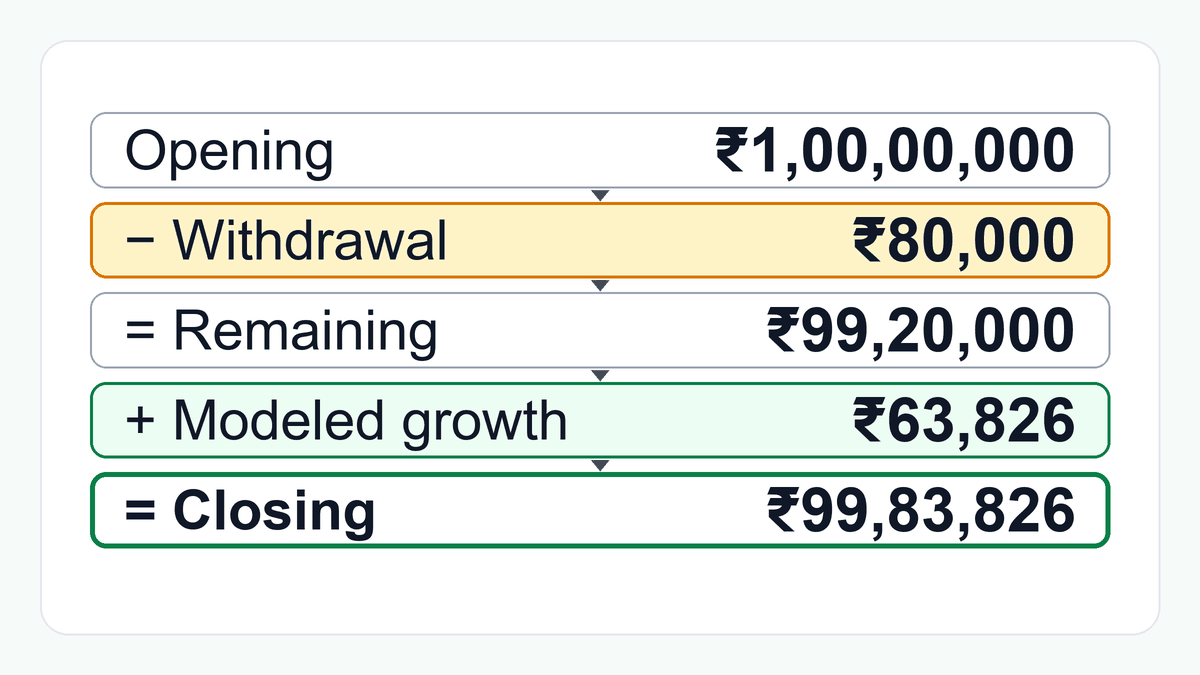
Take a corpus of ₹1,00,00,000, withdrawals of ₹80,000 a month and an assumed return of 8% a year. The corpus is estimated to cover 250 withdrawals in full (20 years 10 months). At 6% or 10% instead, it is estimated to last 15 years 11 months or 47 years 2 months. To use the same corpus up over 25 years, the first withdrawal would be about ₹74,859 a month. And ₹80,000 a month for 25 years would need a starting corpus of about ₹1,06,86,635.
How the Estimate Is Calculated
Each period, the withdrawal is taken first and what is
left grows by one period of the assumed return:
balance = (balance − withdrawal) × (1 + i)
i is (1 + the annual return) raised to 1 divided by the
number of withdrawals a year, minus 1. With a yearly
increase, the withdrawal is multiplied by (1 + the
increase) once at the start of each year. To find how
long a corpus lasts, the calculator repeats this month by
month (or quarter by quarter, or year by year) until a
withdrawal can no longer be paid in full: the part-paid
last withdrawal is counted in the total withdrawn but not
as time.
To find a withdrawal or a corpus for a chosen number of
years, the calculator adds up the value today of every
withdrawal, each discounted by the assumed return. The
corpus needed is the first withdrawal multiplied by that
total, and the first withdrawal a corpus supports is the
corpus divided by it.
SWP Calculator FAQ
What does the assumed return mean?
It is a number you choose to see what a plan could
look like. It is not a prediction and not a promise.
Actual returns can be lower, higher or negative, and
they do not arrive evenly.
Why does a change of ₹1 sometimes change the result a lot?
When a plan only just covers its last withdrawal, a
tiny change in the withdrawal can decide whether that
last withdrawal is paid in full. The calculator
shows a withdrawal rounded down and a corpus rounded
up, so typing the figure back in does not make the
plan look better than the estimate.
Is the yearly increase the same as inflation?
No. It is a percentage you choose. The calculator
does not know or predict inflation, and it does not
adjust anything for it.
Why can other calculators give a slightly different result?
Calculators differ in when the withdrawal is taken
and in how an annual return becomes a monthly one.
This one takes the withdrawal at the start of the
period and treats the entered return as an effective
annual rate.